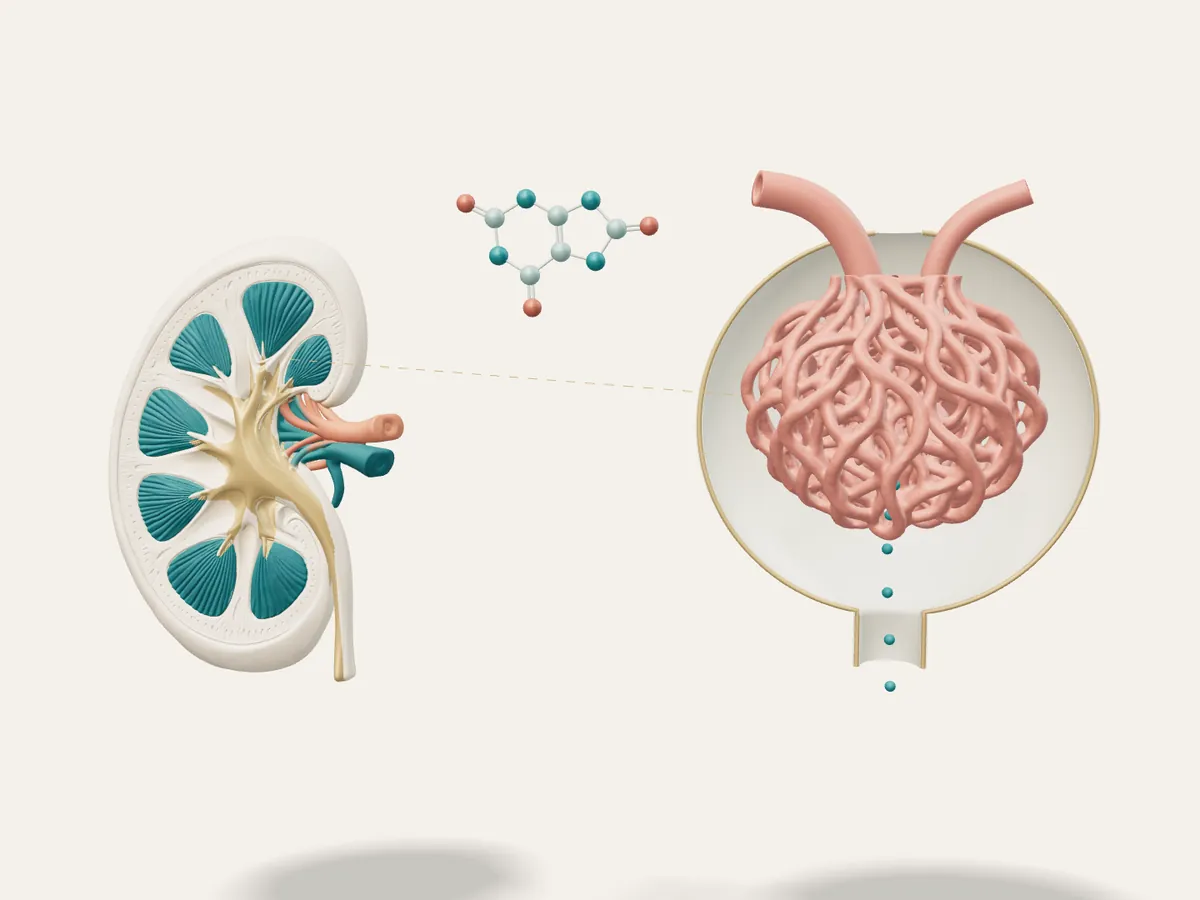
Urate handling by the kidneys
Kidney Health
Uric acid is what your body makes when it breaks down purines, building blocks found in your own cells and in foods such as red meat, offal, shellfish and beer.
Measured in your health assessment, with a doctor to explain your result. Book yours
Urate handling by the kidneys
Unlike most mammals, humans lack the enzyme that breaks uric acid down further, so our levels run high. Above about 0.4 mmol/L it can start to form crystals in the joints, causing gout, the commonest inflammatory arthritis.
A low level is uncommon and rarely significant; some medicines and rare inherited conditions cause it.
High uric acid is linked with gout and kidney stones and goes with obesity, high blood pressure, metabolic syndrome, alcohol (especially beer), sugary drinks sweetened with fructose and some diuretic medicines.
Cutting down on alcohol and sugary drinks, losing excess weight and staying well hydrated all lower uric acid. People with recurrent gout are offered medicines that reduce it, aiming for below 0.36 mmol/L.
NoteGeneral educational illustration. Colours, sizes and movement are simplified. This is not a scan or a simulation of your body. General information, not personal medical advice: a doctor reads your own results with your history.
Measured in your health assessment and explained by the doctor who reviews your results.