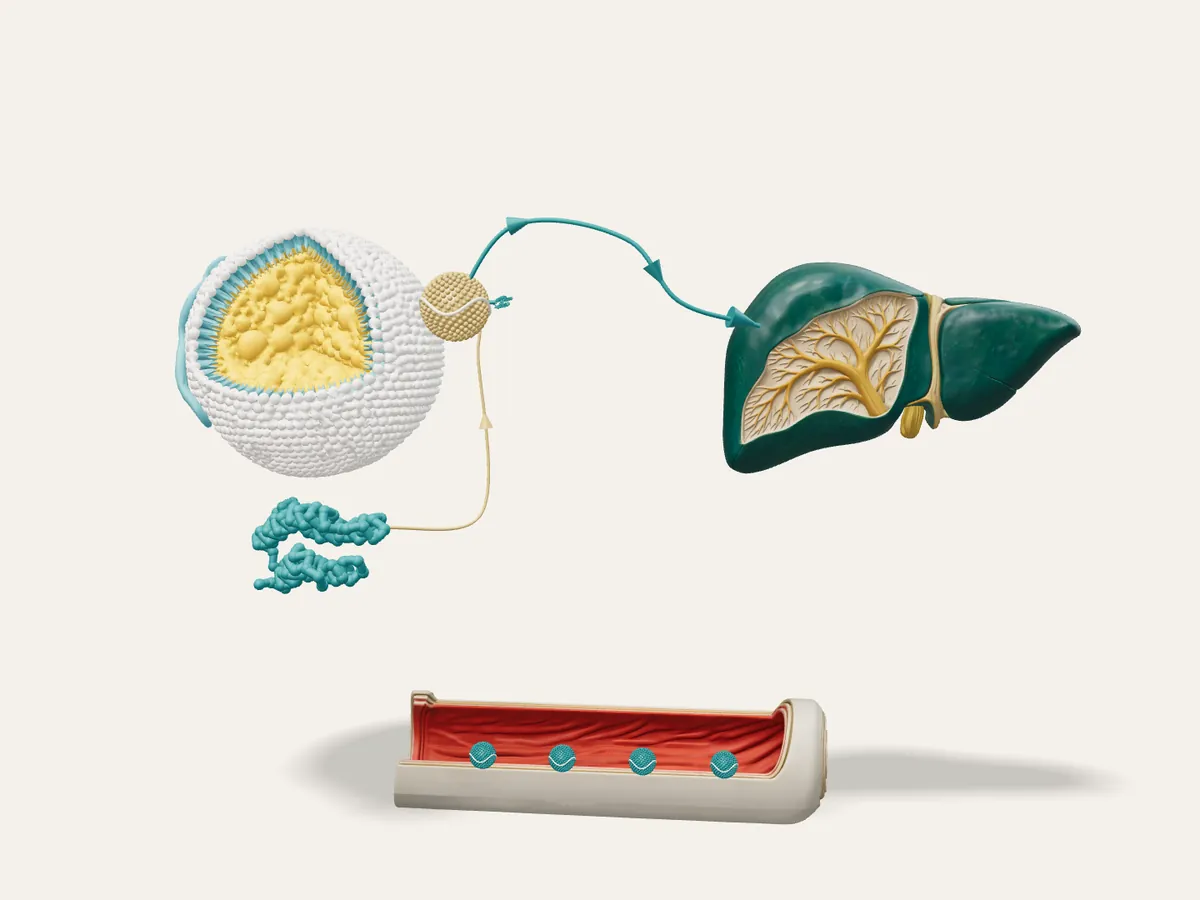
Apo E helps the liver recognise remnants
Heart Health
Apolipoprotein E (ApoE) is a protein on triglyceride-rich particles and some HDL. It works like an address label, telling the liver which particles to pick up and clear.
Measured in your health assessment, with a doctor to explain your result. Book yours
Apo E helps the liver recognise remnants
When ApoE works well, the leftovers of fat-carrying particles, called remnants, are cleared quickly. The ApoE gene comes in three common versions (E2, E3 and E4) that affect cholesterol and, for E4, Alzheimer's risk; this test measures the amount of ApoE in your blood, not which version you carry.
Low levels are usually of no concern.
Higher ApoE usually reflects a build-up of remnant particles, often with high triglycerides. Very high ApoE with raised cholesterol and triglycerides can point to an inherited clearance problem called dysbetalipoproteinaemia, which a lipid specialist can confirm.
Lowering triglycerides, with less sugar and alcohol, weight loss and regular exercise, reduces remnant particles and ApoE with them. The result is always read with your full cholesterol profile.
NoteGeneral educational illustration. Colours, sizes and movement are simplified. This is not a scan or a simulation of your body. General information, not personal medical advice: a doctor reads your own results with your history.
Measured in your health assessment and explained by the doctor who reviews your results.